Aaron Rodgers and Radhakishan Damani: Two Very Different Paths to Success
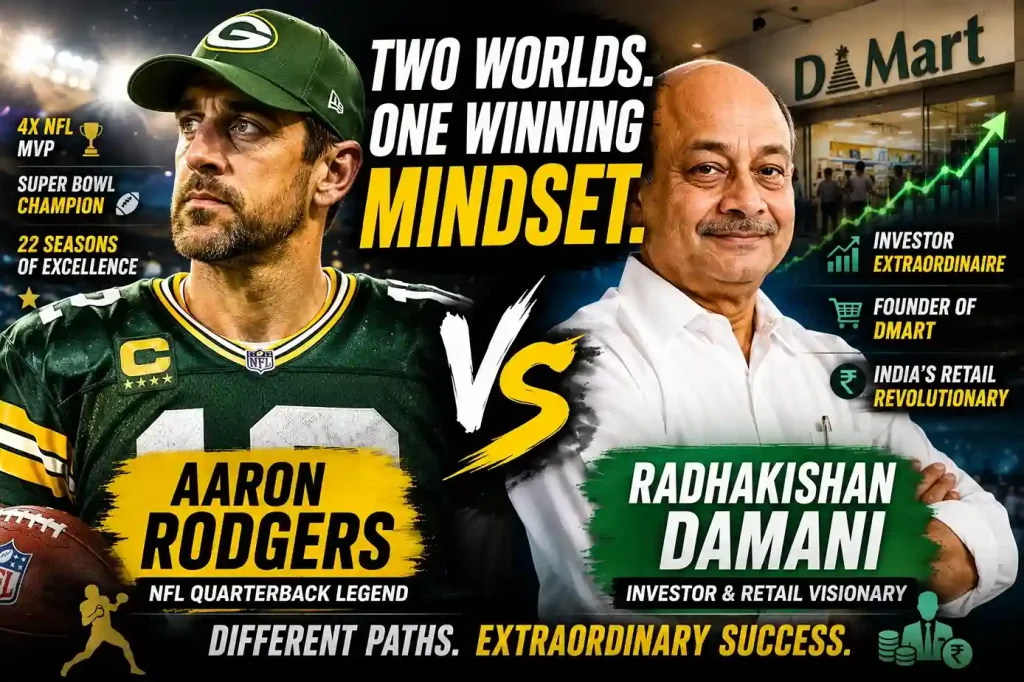
Aaron Rodgers and Radhakishan Damani built their careers in completely different industries.
Rodgers became one of the most accomplished quarterbacks in NFL history. His career has included four NFL MVP awards, a Super Bowl victory, and more than two decades of professional football.
Damani built his reputation through investing and retail. He founded Avenue Supermarts, the company behind DMart, and became one of India’s most prominent business figures.
There is no major professional relationship between Aaron Rodgers and Radhakishan Damani. Their names are better understood through a comparison of two different approaches to success: elite sports performance and disciplined business building.
| Aaron Rodgers | Radhakishan Damani |
|---|---|
| Professional football quarterback | Investor and entrepreneur |
| United States | India |
| NFL | Investments and retail |
| Pittsburgh Steelers | Avenue Supermarts and DMart |
| Four-time NFL MVP | Founder of DMart |
| Super Bowl champion | Major Indian retail entrepreneur |
| Highly public career | Relatively private business profile |
Who Is Aaron Rodgers?
Aaron Rodgers is an American professional football quarterback who has spent more than two decades in the NFL.
He entered the league in 2005 after being selected by the Green Bay Packers in the first round of the NFL Draft. Rodgers eventually replaced Brett Favre as Green Bay’s starting quarterback and developed into one of the league’s most accomplished players.
His career is known for:
- Accurate passing
- Strong arm talent
- Quick decision-making
- Quarterback mobility
- Touchdown production
- Late-game performance
- Leadership under pressure
Rodgers spent most of his career with the Packers before later playing for the New York Jets and Pittsburgh Steelers.
Aaron Rodgers’ NFL Career
Rodgers spent 18 seasons with Green Bay and became the franchise’s starting quarterback after Favre’s departure.
He led the Packers to a Super Bowl victory following the 2010 season. Rodgers was named Super Bowl XLV MVP after Green Bay defeated the Pittsburgh Steelers.
His individual awards also became a major part of his legacy.
Rodgers has won four NFL MVP awards, placing him among the most decorated quarterbacks in league history.
His career eventually continued in New York and then Pittsburgh.
According to the NFL, Rodgers played 2025 with the Steelers, throwing for 3,322 yards with 24 touchdowns and seven interceptions while helping Pittsburgh win the AFC North. (NFL.com)
Aaron Rodgers and the Pittsburgh Steelers
Rodgers’ career entered another chapter when he joined the Pittsburgh Steelers.
After initially considering retirement following the 2025 season, Rodgers agreed to return to Pittsburgh on a one-year contract for the 2026 season. The deal was reported to include $22 million guaranteed and could reach $25 million with incentives. (NFL.com)
In July 2026, Rodgers confirmed that the 2026 season would be his final NFL season.
He described the upcoming campaign as his last and reported to training camp for what will be his 22nd professional season. (NFL.com)
That makes the current stage of Rodgers’ career particularly significant.
He is now attempting to finish his NFL career with another season in Pittsburgh.
What Made Aaron Rodgers Successful?
Rodgers’ career was built on several traits that helped him remain productive for an unusually long period.
Accuracy
Rodgers developed a reputation for precise passing, especially on difficult throws into tight coverage.
Football Intelligence
Reading defensive formations and recognizing coverage changes became important parts of his game.
Decision-Making
Quarterbacks have limited time to make decisions. Rodgers’ ability to adjust before and during plays became one of his defining strengths.
Arm Strength
His ability to make deep and difficult throws gave opposing defenses another challenge.
Longevity
Remaining an elite quarterback across multiple generations of NFL players is difficult.
Rodgers has played professionally since 2005 and is entering his 22nd NFL season in 2026. (NFL.com)
Who Is Radhakishan Damani?
Radhakishan Damani is an Indian investor, entrepreneur, and businessman best known as the founder of DMart and Avenue Supermarts.
Unlike Rodgers, Damani has maintained a relatively low public profile.
His reputation comes primarily from his investment decisions and the growth of his retail business.
DMart describes Damani as an astute investor in the Indian equity market and identifies him as the founder of Avenue Supermarts, the company that owns and operates DMart. (DMart)
His career demonstrates how a relatively quiet investment strategy can eventually produce one of India’s largest retail businesses.
Radhakishan Damani’s Early Investment Career
Damani first became known in India’s financial markets as an investor and stock market professional.
His approach emphasized business fundamentals rather than short-term excitement.
He became known for studying companies carefully and taking positions based on his assessment of their long-term potential.
Forbes has described him as a veteran Mumbai investor whose wealth initially developed through investments before his retail business became a major source of his fortune. (Forbes)
This investment background later influenced the way he developed DMart.
How Radhakishan Damani Built DMart
Damani entered the retail business in 2002.
The first DMart store opened in Powai, Mumbai.
Instead of attempting to create a luxury shopping experience, the business focused on everyday products and competitive pricing.
DMart’s product categories include:
- Groceries
- Toiletries
- Clothing
- Kitchen products
- Home appliances
- Beauty products
- Household goods
- Personal-care products
The company’s stated mission is to provide customers with value through competitive pricing. (DMart)
This simple approach became an important part of DMart’s growth strategy.
Why DMart Became Successful
DMart’s success has been associated with operational efficiency and cost control.
The company focuses heavily on value pricing and everyday consumer demand.
Forbes reported that Damani started DMart with one store in suburban Mumbai and gradually expanded the business into a major national retail chain. (Forbes)
The strategy differs from many retailers that rely heavily on premium stores and aggressive marketing.
DMart instead developed around:
- Competitive prices
- Everyday consumer products
- Cost discipline
- Efficient operations
- Store expansion
- Strong understanding of customer demand
That approach helped turn a single Mumbai store into a major Indian retail network.
Avenue Supermarts and DMart
Avenue Supermarts Limited owns and operates DMart.
The company was founded by Radhakishan Damani and operates the retail chain across multiple Indian states.
DMart says its stores have expanded across markets including Maharashtra, Gujarat, Karnataka, Telangana, Andhra Pradesh, Tamil Nadu, Madhya Pradesh, Rajasthan, Punjab, Delhi NCR, Chhattisgarh, Uttar Pradesh, Haryana, Goa and other regions. (DMart)
This expansion demonstrates the scale of the business Damani created.
Radhakishan Damani’s Investment Philosophy
Damani’s investment reputation is closely associated with patience and fundamentals.
Rather than constantly chasing market trends, his approach has generally emphasized:
- Business fundamentals
- Long-term value
- Cost control
- Patience
- Careful capital allocation
- Understanding the underlying business
DMart’s own corporate profile describes Damani as a believer in core business fundamentals and strong ethical values. (DMart)
This philosophy connects his investment career with his approach to retail.
Aaron Rodgers vs. Radhakishan Damani
Although their professions are completely different, comparing their career approaches reveals some interesting similarities.
| Category | Aaron Rodgers | Radhakishan Damani |
|---|---|---|
| Industry | Professional sports | Investments and retail |
| Country | United States | India |
| Main profession | NFL quarterback | Investor and entrepreneur |
| Major organization | Pittsburgh Steelers | Avenue Supermarts |
| Best known for | NFL career and four MVP awards | DMart and investment success |
| Success driver | Athletic skill and preparation | Research and business discipline |
| Public profile | Extremely high | Relatively private |
| Career approach | Competitive performance | Long-term business building |
Two Different Definitions of Success
Rodgers and Damani demonstrate that professional success can take very different forms.
For Rodgers, success is measured through:
- Wins
- Passing statistics
- Awards
- Championships
- Records
- Individual performances
For Damani, success is measured through:
- Investment returns
- Business growth
- Store expansion
- Company performance
- Retail efficiency
- Long-term wealth creation
Neither model requires the same skills.
An elite quarterback needs physical ability, reaction speed, tactical intelligence, and competitive resilience.
An investor and retailer needs financial judgment, patience, market knowledge, operational discipline, and long-term planning.
Preparation: A Common Theme
One of the strongest similarities between Rodgers and Damani is preparation.
Rodgers spent years studying defenses, practicing throws, understanding offensive systems, and preparing for opponents.
Damani built his reputation through studying businesses and financial opportunities.
The activities are completely different, but the principle is similar.
Preparation reduces the need to rely on luck.
In football, preparation helps a quarterback recognize situations faster.
In investing, research helps an investor understand potential risks and opportunities before committing capital.
Patience Played Different Roles
Patience also appears in both careers.
Rodgers had to develop his career over many seasons and adjust as the NFL changed.
Damani’s retail business required a much longer approach.
DMart began with one store in 2002. The company then expanded over many years rather than attempting to build a national network immediately. (DMart)
This illustrates an important difference between short-term success and sustainable growth.
Leadership Styles
Aaron Rodgers’ leadership developed within a team environment.
A quarterback must communicate with teammates, understand the offensive system, and perform when games are decided by small margins.
Damani’s leadership developed within business.
His influence came through investment decisions, company strategy, cost discipline, and retail expansion.
The environments are different, but both require confidence in decision-making.
Publicity vs. Privacy
The contrast in their public profiles is striking.
Rodgers has spent his career under constant sports-media attention.
NFL games are broadcast globally, while interviews, statistics, contracts, injuries, and performances generate regular coverage.
Damani has generally maintained a much quieter public profile.
Forbes describes him as a low-profile investor whose reputation developed largely through investment and retail success. (Forbes)
This shows that becoming highly successful does not require becoming highly visible.
How Their Careers Created Wealth
The two men also built wealth through very different mechanisms.
Aaron Rodgers
A professional athlete can generate wealth through:
- NFL contracts
- Performance bonuses
- Endorsements
- Sponsorships
- Commercial partnerships
- Investments
Rodgers’ wealth is closely connected to his long NFL career and commercial profile.
Radhakishan Damani
Damani’s wealth is primarily connected with:
- Avenue Supermarts
- DMart
- Public-market investments
- Private investments
- Real estate holdings
Forbes’ July 2026 profile estimated Damani’s real-time net worth at approximately $14.7 billion, although such figures can change with market prices and asset valuations. (Forbes)
Why Aaron Rodgers and Radhakishan Damani Are Compared
There is no major documented business partnership between Rodgers and Damani.
Their comparison is interesting because both became extremely successful while following very different professional systems.
Rodgers represents the world of elite professional athletics.
Damani represents investment and retail entrepreneurship.
Their names can therefore be paired around broader themes such as wealth, discipline, leadership, success, and career achievement without implying that they personally worked together.
Is There a Business Connection Between Aaron Rodgers and Radhakishan Damani?
There is no well-documented major business partnership between Aaron Rodgers and Radhakishan Damani.
There is no established evidence that they:
- Own a company together
- Operate a joint investment
- Run a shared business
- Have a major endorsement partnership
- Founded a company together
- Have a documented professional collaboration
Their careers have developed independently.
Rodgers’ professional world is centered on American football and sports.
Damani’s career is centered on Indian investments and retail.
What Can Entrepreneurs Learn From Damani?
Damani’s career offers several useful business lessons.
Focus on Fundamentals
DMart’s growth was built around everyday consumer needs rather than unnecessary complexity.
Control Costs
Competitive retail requires strict attention to operating costs.
Think Long Term
Building a national retail chain takes years.
Understand Customers
DMart’s business model focuses heavily on providing value to everyday shoppers. (DMart)
Avoid Unnecessary Publicity
Damani’s career demonstrates that business influence does not require constant media exposure.
What Can Professionals Learn From Rodgers?
Rodgers’ career offers a different set of lessons.
Develop a Specialized Skill
Elite performance begins with mastery of core skills.
Prepare Consistently
Preparation becomes especially important when performance is measured publicly.
Adapt to Change
Rodgers played across different coaching systems, teams, and stages of his career.
Perform Under Pressure
Professional sports provide little room for hesitation during crucial moments.
Maintain Longevity
Remaining productive across multiple decades requires constant adaptation.
Aaron Rodgers and Radhakishan Damani: Main Similarities
Despite the huge differences between them, several broad similarities stand out.
Preparation: Both careers depended heavily on preparation.
Discipline: Neither achieved success through a single lucky opportunity.
Patience: Both developed their careers over long periods.
Decision-making: Rodgers makes decisions during fast-moving games, while Damani makes decisions involving businesses and investments.
Leadership: Both became influential figures within their respective professional environments.
Consistency: Long-term performance has been important to both careers.
Aaron Rodgers and Radhakishan Damani: Main Differences
Their differences are even more significant.
Rodgers works in a competitive team sport where performance can be measured every week.
Damani works in financial markets and retail, where business decisions may take years to produce their full results.
Rodgers is a highly visible public figure.
Damani has traditionally preferred a quieter profile.
Rodgers’ career is built around athletic performance.
Damani’s career is built around capital allocation, retail operations, and business ownership.
A Career Comparison in One View
| Aaron Rodgers | Radhakishan Damani |
|---|---|
| Athlete | Investor |
| Quarterback | Entrepreneur |
| NFL | Indian retail |
| Game-day decisions | Investment decisions |
| Team leadership | Business leadership |
| Performance measured weekly | Growth measured over years |
| Public celebrity | Private businessman |
| Sports wealth | Business and investment wealth |
Final Thoughts on Aaron Rodgers and Radhakishan Damani
Aaron Rodgers and Radhakishan Damani reached extraordinary levels of success without following remotely similar career paths.
Rodgers became one of the NFL’s most accomplished quarterbacks. His career includes four MVP awards, a Super Bowl championship, and more than two decades of professional football. He is now preparing for his final NFL season with the Pittsburgh Steelers in 2026. (NFL.com)
Damani built his fortune through investing and entrepreneurship. His creation of DMart transformed a single Mumbai store launched in 2002 into a major Indian retail business. (DMart)
Their professional worlds have little direct overlap.
Yet their stories share a broader lesson.
Success can come from very different forms of discipline.
Rodgers demonstrates the value of preparation, skill development, adaptability, and performance under pressure.
Damani demonstrates the value of research, patience, cost control, and long-term business thinking.
Neither career offers a single formula for success. Together, however, they show how sustained discipline can create exceptional results in both sports and business.