Palmer Luckey and Jeff Greene: Two Billionaires With Very Different Paths to Success
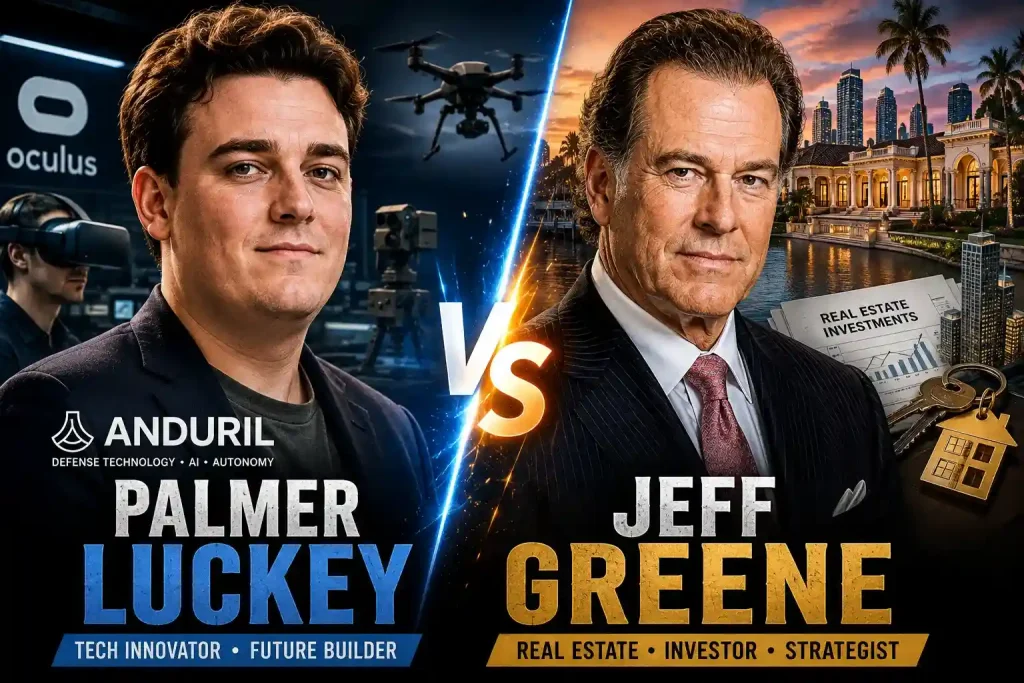
Palmer Luckey and Jeff Greene built extraordinary fortunes through completely different industries.
Luckey became a technology entrepreneur after developing the Oculus Rift and co-founding Oculus VR. He later moved into defense technology through Anduril Industries.
Jeff Greene followed a different path. He built his wealth through financial markets, real estate investments, and property development.
Despite their different backgrounds, ages, and industries, both entrepreneurs share an important trait: they were willing to take calculated risks when they saw opportunities others overlooked.
Palmer Luckey Profile
| Detail | Information |
|---|---|
| Full Name | Palmer Freeman Luckey |
| Born | September 19, 1992 |
| Birthplace | Long Beach, California |
| Profession | Technology Entrepreneur |
| Known For | Oculus VR and Anduril Industries |
| Main Industries | Virtual Reality and Defense Technology |
| Education | California State University, Long Beach |
Palmer Luckey became one of the youngest technology entrepreneurs to build a major fortune through virtual reality.
His career later expanded into defense technology, artificial intelligence, autonomous systems, and advanced hardware.
Palmer Luckey’s Early Life
Luckey developed an interest in electronics, computers, gaming, and engineering while he was still young.
He spent much of his teenage years experimenting with electronic equipment and modifying gaming systems. His interest eventually turned toward virtual reality.
Traditional virtual reality headsets were often expensive, uncomfortable, and difficult to use. Luckey believed there was an opportunity to create more accessible hardware.
His early experiments eventually produced a prototype that became the foundation for the Oculus Rift.
Education and Early Technology Work
Luckey attended California State University, Long Beach, where he studied journalism and became increasingly involved in virtual reality development.
He eventually left college before completing his degree.
Instead, he focused his attention on building Oculus and developing virtual reality hardware.
That decision became one of the most important turning points in his career.
The Creation of Oculus VR
Luckey founded Oculus VR in 2012.
The company focused on developing virtual reality headsets for gaming and immersive digital experiences.
The Oculus Rift attracted attention from developers, technology enthusiasts, and investors because it offered a more affordable approach to consumer virtual reality.
A successful crowdfunding campaign helped the company develop its technology and expand its reach.
The project soon attracted attention from major technology companies.
Facebook Acquires Oculus
In 2014, Facebook announced an agreement to acquire Oculus VR for approximately $2 billion.
Luckey was only 21 years old at the time.
The acquisition transformed Oculus from a small technology startup into part of one of the world’s largest technology companies.
It also established Luckey as one of the most recognizable young entrepreneurs in the technology industry.
The deal became an important milestone in the development of mainstream virtual reality.
Palmer Luckey Leaves Facebook
Luckey eventually left Facebook in 2017.
His departure followed controversy surrounding his political activities and public profile.
After leaving the company, he did not simply retire from technology.
Instead, he moved into an industry that was very different from consumer entertainment.
That industry was defense technology.
Palmer Luckey and Anduril Industries
Luckey co-founded Anduril Industries in 2017 with several technology executives.
The company focuses on advanced defense and national security technology.
Its work includes:
- Artificial intelligence
- Autonomous systems
- Drones
- Surveillance technology
- Defense software
- Unmanned systems
- Command and control technology
Anduril’s development represents a major change from Luckey’s earlier work with gaming and virtual reality.
However, both businesses rely heavily on advanced hardware, software, engineering, and emerging technology.
Anduril’s Rapid Growth
Anduril attracted significant investment as governments and defense organizations increased their interest in autonomous technology.
The company’s growth has also increased the value of Luckey’s ownership stake.
Because Anduril remains privately held, estimates of Luckey’s wealth can change when investors place a new valuation on the company.
This makes his reported net worth more difficult to calculate precisely than the wealth of an entrepreneur whose assets are primarily publicly traded shares.
Palmer Luckey and ModRetro
Luckey has also maintained an interest in gaming hardware.
His involvement with ModRetro reflects his continued connection to the gaming community that influenced his early career.
The company focuses on retro gaming hardware and products inspired by classic gaming systems.
This side of his career demonstrates that Luckey’s interests extend beyond defense technology.
Jeff Greene Profile
| Detail | Information |
|---|---|
| Full Name | Jeffrey Bennett Greene |
| Born | December 10, 1954 |
| Birthplace | Worcester, Massachusetts |
| Profession | Investor and Real Estate Entrepreneur |
| Main Industries | Real Estate and Financial Markets |
| Education | Johns Hopkins University |
| Graduate Education | Harvard Business School |
| Primary Wealth Sources | Real Estate and Investments |
Jeff Greene built his fortune through a combination of financial investing and real estate.
Unlike Luckey, Greene did not become wealthy by creating a technology company.
His career was shaped by property ownership, financial market strategies, and long-term investments.
Jeff Greene’s Early Life
Greene grew up in Worcester, Massachusetts.
His family later moved to Florida after financial difficulties affected his father’s business.
Greene worked various jobs while pursuing his education.
He attended Johns Hopkins University, where he studied economics and sociology.
He later earned an MBA from Harvard Business School.
His early experiences with work and financial limitations influenced his approach to money and investment.
Jeff Greene’s First Real Estate Investments
Greene began investing in property while studying at Harvard Business School.
One of his early purchases was a three-family house near Boston.
He lived in one part of the property and rented the remaining units.
This gave him practical experience with property management, rental income, and real estate investing.
By the time he completed his graduate studies, he had accumulated a portfolio of properties.
That early experience eventually became the foundation of his larger real estate business.
Jeff Greene and the 2008 Financial Crisis
One of the most important chapters of Greene’s career involved the U.S. housing market.
Before the 2008 financial crisis, Greene purchased credit default swaps connected to subprime mortgage-backed securities.
These financial instruments increased in value as the housing market deteriorated.
The strategy generated a substantial return.
Greene subsequently used much of his wealth to expand into real estate and other investments.
This decision helped transform him from a financial-market investor into a major property owner.
Building a Real Estate Empire
Real estate eventually became the central component of Greene’s wealth.
His investments have included:
- Apartment buildings
- Commercial properties
- Luxury residences
- Development projects
- Office buildings
- Retail properties
His property interests have included major markets such as Los Angeles and South Florida.
Greene’s strategy has focused on acquiring valuable properties and building long-term wealth through ownership and investment.
Palazzo di Amore
One of Greene’s best-known properties is Palazzo di Amore in Beverly Hills.
The luxury estate attracted significant attention because of its enormous size, architecture, and extensive amenities.
The property became an example of Greene’s involvement in the luxury real estate market.
Jeff Greene’s Investment Philosophy
Greene’s career demonstrates a strong focus on identifying opportunities during periods of market uncertainty.
His approach has included:
- Careful market analysis
- Long-term property ownership
- Strategic financial investments
- Diversification
- Opportunistic acquisitions
- Reinvestment of profits
His experience during the housing crisis became one of the defining examples of this strategy.
Palmer Luckey vs. Jeff Greene
Although both are wealthy entrepreneurs, their careers have very different foundations.
| Category | Palmer Luckey | Jeff Greene |
|---|---|---|
| Birth Year | 1992 | 1954 |
| Main Industry | Technology | Real Estate |
| Major Business | Oculus and Anduril | Real Estate Ventures |
| First Major Fortune | Virtual Reality | Financial Markets |
| Current Focus | Defense Technology and Innovation | Real Estate and Investments |
| Education | California State University, Long Beach | Johns Hopkins and Harvard Business School |
| Business Style | Technology-driven | Investment-driven |
| Primary Assets | Technology company stakes | Property and financial investments |
The biggest difference is how they created their initial fortunes.
Luckey built technology.
Greene invested capital.
Palmer Luckey and Jeff Greene Wealth Comparison
Reported wealth estimates place both men among America’s billionaire entrepreneurs.
Recent estimates have placed Palmer Luckey’s fortune at around $5 billion, while Jeff Greene’s fortune has been estimated at approximately $9 billion.
These figures should not be viewed as permanent totals.
Luckey’s wealth is heavily influenced by the private valuation of Anduril and his ownership interests in technology companies.
Greene’s wealth is influenced by property values, financial investments, and market conditions.
Both fortunes can therefore change significantly over time.
How Palmer Luckey Built His Fortune
Luckey’s wealth creation followed a technology entrepreneurship model.
His career can be summarized in several stages:
- Experimenting with virtual reality hardware
- Creating the Oculus Rift
- Founding Oculus VR
- Selling Oculus to Facebook
- Moving into defense technology
- Co-founding Anduril
- Expanding into additional technology projects
His greatest strength has been identifying emerging technologies with significant long-term potential.
How Jeff Greene Built His Fortune
Greene’s path was more investment-focused.
His career developed through:
- Early property investments
- Financial market trading
- Successful positions during the housing crisis
- Reinvestment into real estate
- Property development
- Expansion across major U.S. markets
Rather than depending on one company, Greene built wealth through a broad portfolio of assets.
What Do Palmer Luckey and Jeff Greene Have in Common?
Their careers may appear unrelated, but several similarities stand out.
Calculated Risk
Both entrepreneurs were willing to take significant risks.
Luckey entered virtual reality when the technology was still developing.
Greene made major financial positions before the housing market collapsed.
Neither strategy was guaranteed to succeed.
Long-Term Thinking
Both men also looked beyond immediate opportunities.
Luckey continued developing technology after the Oculus acquisition.
Greene used financial profits to build a long-term real estate portfolio.
Their careers show the importance of reinvesting success rather than relying on one major transaction.
Independent Business Thinking
Neither entrepreneur followed a conventional corporate path.
Luckey left university before completing his degree and focused on building technology.
Greene developed his own investment strategy through education, property ownership, and financial markets.
Their stories demonstrate how unconventional career paths can produce significant results when combined with strong execution.
Are Palmer Luckey and Jeff Greene Business Partners?
There is no established major business partnership between Palmer Luckey and Jeff Greene.
Their professional interests remain separate.
Luckey’s businesses focus on technology, defense, artificial intelligence, autonomous systems, and gaming hardware.
Greene’s portfolio focuses primarily on real estate, financial investments, and property development.
There is no widely documented joint company or major shared investment connecting the two.
Palmer Luckey vs. Jeff Greene: Who Is Wealthier?
Based on recent reported estimates, Jeff Greene has the larger fortune.
Greene’s estimated wealth of approximately $9 billion exceeds Luckey’s reported $5 billion.
However, the comparison can change as market conditions change.
Luckey’s wealth is particularly sensitive to private technology valuations.
Greene’s fortune can move with real estate prices and financial markets.
Therefore, billionaire rankings should always be treated as estimates rather than fixed amounts.
Philanthropy and Public Interests
Jeff Greene has also devoted part of his wealth to education and philanthropy.
His charitable interests include educational initiatives and projects designed to provide opportunities for young people.
Luckey has maintained a more technology-focused public profile.
His interests include gaming, engineering, technology, vehicles, and defense innovation.
Their philanthropic and personal interests therefore reflect the different industries that shaped their careers.
What Can Entrepreneurs Learn From Their Careers?
The careers of Palmer Luckey and Jeff Greene offer several useful lessons.
Find an Underserved Opportunity
Luckey saw limitations in existing virtual reality hardware.
Greene identified opportunities in property and financial markets.
Successful entrepreneurs often begin by finding a problem or opportunity that others have overlooked.
Accept Calculated Risk
Neither man avoided risk.
The important lesson is not simply to take risks. It is to understand the potential reward, downside, and timing before making a major decision.
Reinvest Your Success
Both entrepreneurs used early success to pursue larger opportunities.
Luckey moved from Oculus into defense technology.
Greene moved from financial-market gains into large-scale real estate investments.
Reinvestment allowed both to build beyond their first major achievements.
Final Comparison
Palmer Luckey and Jeff Greene represent two completely different approaches to wealth creation.
Luckey built his reputation through technology. His development of Oculus helped popularize consumer virtual reality, while Anduril established him as an important figure in defense technology.
Greene built his fortune through investing. His financial-market success during the housing crisis provided capital that he later deployed into real estate and other investments.
Their industries may have little in common, but their careers share a broader lesson.
Luckey created value through technology and innovation, while Greene created wealth through investment and asset ownership.
Neither followed a traditional path to success. Both identified opportunities, accepted calculated risks, and continued expanding after their first major breakthroughs.